


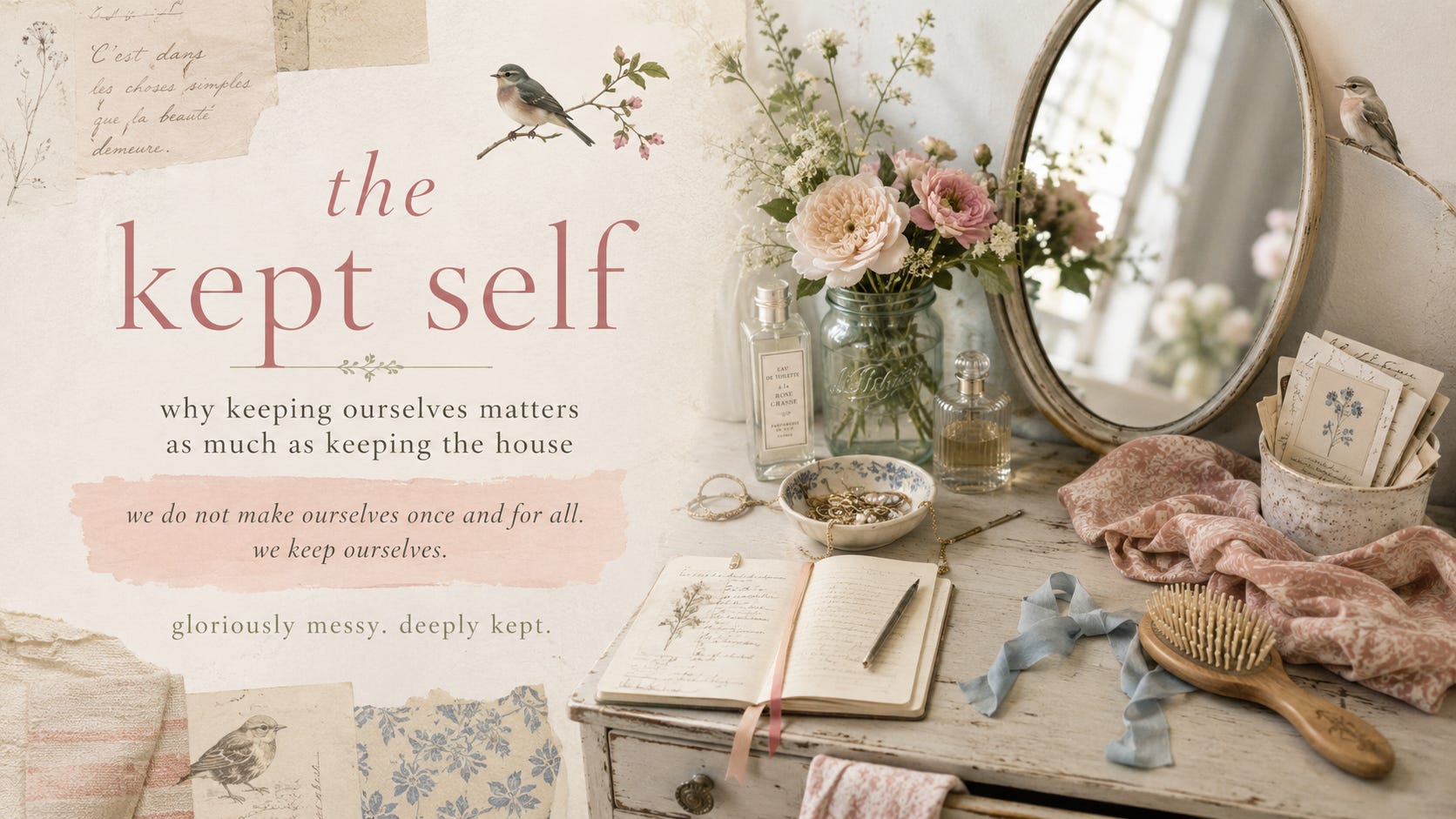
There’s a reason I chose the word keeping. A reason beyond whimsy, though I adore whimsy, and a reason beyond the pretty, though the pretty has long been redemption in a world determined to get uglier by the day.
Twenty something years ago I sat down at a computer the size of a bread bin and named the thing I did. I called it vintage housekeeping, and I remember the small click of rightness when I typed it. A little phrase. A small flag planted in the wacky soil of the early internet. Because I wanted a way to describe the business of tending a home with more reverence than was fashionable and more feeling than was strictly sensible. And until that evening, sitting on my yellow velvet sofa, it didn’t exist.
And then it wandered off in a thousand aprons.
It came back as vintage homemaking. It appeared on blogs everywhere, plumped and softened and sometimes made so sweet it gave me a toothache in my eye. Which is fine. Language does that. It breeds. It borrows shoes. It runs off with women in Utah and women making sourdough in Yorkshire, and bless it, truly, but every time I saw it I felt the way you feel when somebody folds your towels in half instead of thirds. Politely murderous.
Because I chose house/keeping on purpose.
Making, you see, is a word with a finish line in it. Making implies arrival. Making suggests one might someday stand in the doorway, wipe one’s hands on one’s yoga pants, survey the whole gorgeous arrangement and say, there, done! As if a home were a cake. As if the soul could be assembled on a Sunday afternoon with nowt but a glue gun, a hope and a prayer.
But keeping is different.
Keeping is the daily returning. Keeping is the matter of devotion after inspiration has flounced out the room. Keeping is what happens when the floor is vulgar again by lunchtime, when the flowers are shedding their little sorrows into the water, when the fridge has become unspeakable and some invisible little gremlin has seen fit to refill the laundry basket while your back was turned.
Keeping is the word we use for the things that would wander off without us.
We keep bees and we keep promises.
We keep vigils at the bedsides of the people we love. A lighthouse keeper didn’t make the light, she returned to it, night after night after night, up the cold spiral of the stairs in all weathers, because a light that gets lit once is just a memory of a light. The keeping was the job.
And a house is exactly that sort of creature. All loose morals and wild ideas. Alive, and therefore the work is alive? Turn your back on it for a fortnight and the dust bunnies move in carrying all manner of odds and sods you don’t remember ordering. I found this devastating at twenty five and I find it comforting now, because it means the house and I are in a relationship rather than a transaction, and relationships are kept up. Attended to. Visited daily with small offerings of beeswax and open windows.
The house, you see, is where the truth leaks out. You can say you’re fine, then find yourself unable to open the post for seventeen days. You can say you’re liberated, then realise you’ve been feeding everyone except yourself with the miserable holiness of a martyr in need of a marmite toastie.
The house knows. She is a witness with skirting boards.
So far so domestic. You knew all this. You’ve been keeping house alongside me for years, some of you for decades, you could grade my linen cupboard from memory.
Here is the part it took me until my fifties to say out loud -
What is true of the house is true of the woman who lives inside it. We don’t make ourselves once and for all. We keep ourselves. Or we forget to, and discover what forgetting costs.
We kept thinking, didn’t we, that one day, there would be a finished version of us? Eventually. A made self. We’d lose the weight or survive the divorce or get the children grown and launched, and then, ta dah, the self would be complete and we could finally stand back from her with our hands on our hips. We treated ourselves like a project with a delivery date. Like a loft conversion. Or a new conservatory.
But darling, you were never a project. You were always a house. A rambling, draughty, peculiar old property with good bones and a history, and you require keeping. Daily, faithful keeping. The kind nobody applauds.
The kept self has not solved herself. There is no solution to be had and hell’s bells, what a tedious dinner guest she would be, if there were. She has probably cried in supermarket car parks. She has probably made several life decisions while dehydrated and wearing shoes that were creating blisters in her head.
The kept self is the woman who notices. That’s all at first?
She notices the way she has started speaking to herself as if she were an employee on a written warning. She notices the hour at which she begins to disappear. She notices the small bureaucracies of neglect: the prescription not collected, the book not opened, the bra that fits like a punishment, the meal deferred until she is all snarl and static.
Then, because she is a Brocante woman, which is to say a woman of peculiar courage and unreasonable taste, she does one tiny thing.
She cuts fruit into a bowl because apparently she’s not livestock. She opens the bedroom window because her thoughts have gone stale. She puts clean sheets on the bed and understands, briefly, that civilised society was invented for this exact moment. She writes one sentence that has been tapping on the inside of her skull since March. She turns down an invitation because her spirit has started making fax-machine noises.
She does the small thing and the small thing becomes a hinge.
And she needs the hinge, because life is erosive. Every day takes a little. Noise takes a little. Money fear takes a little. Men with mad ideas take a little. Children, even grow-up beloved children, take a little. Hormones take a little then leave the room laughing. Grief takes rather more than it was offered and doesn’t always return the silver.
Without keeping, we are worn away. We become all edge and obligation. We become capable in the way a mule is capable. Women who can remember everyone’s dental appointment but can’t remember what music once made us feel like we had a bloodstream full of stars.
Which brings me, by way of the scenic route, to Brocante 75.
Seventy five days. Forever is too enormous and too bossy, and the brittle online sort of challenge turns everyone unbearable by day nine, smug like a protein powder advert. Seventy five days is a container. A period of gentle allegiance. A domestic novena for the muddled, the clever, the overheated, the grieving, the hungry, and the unfinished.
Five small practices, every day, for seventy five days. Five candles lit in the lighthouse of you, daily, in all weathers. Come rain or shine.
Because muchy, gloriously messy women like us need frames. We are wild within them, that’s the trick. Too much freedom and we evaporate into tabs and intentions and half-formed revolutions. Too much rigidity and we become furious little goats, kicking against the pen. But a chosen frame, a lovely serious ridiculous frame, gives the day somewhere to pour itself, doesn’t it?
People ask me, (they always ask me), what happens when I fail? When I miss a day?
And oh, the relief of this answer. You probably WILL fail and when you do, you repair. You don’t restart.
Because what does a housekeeper do when she finds the milk gone over and the floor unswept after a hard week? She doesn’t burn the house down and apply for a new one, now does she? She opens a window. She sweeps the one floor. The house receives her back without a single word of reproach, because houses, unlike diets, hold no grudges. You missed three days? The kept self has dust on the mantel, that’s all. It tells you where to put the cloth.
I know the modern mind flinches at commitment. We’ve been sold spontaneity as proof of authenticity, as though the self is most real when it is unbound, rampaging through the day like a bull in proverbial china shop. But devotion is what makes freedom habitable. A piano player becomes free through scales. A woman becomes free, sometimes, through the small ceremonial insistence that she will not abandon herself before breakfast.
This is where the word religion becomes useful, and I mean it in the old, earthy sense, religare, to bind back, or to tie again. A religion in the domestic sense is simply the set of things you’ve bound yourself to. The things you do because you do them. The housekeeper has always had one, she just never called it that. Monday’s wash and Friday’s floors. The rituals before Christmas. Liturgy in an apron.
Simple religion. The religion of lighting the room before dusk gets its teeth in. The religion of making the bed even when the world has no manners. The religion of reading a page instead of zoning out in front of a screen.
The religion of putting yourself on the list of all the things that require tenderness.
Commitment, it turns out, is much lighter than motivation ever was. Motivation has to be summoned, fresh, every morning, like a difficult houseguest who has to be coaxed downstairs. Commitment got up before you did and has already put the porridge on.
And the question commitment keeps asking, the question at the heart of the 75, is this. What keeps ME?
What keeps me from fraying beyond recognition? What keeps me kind without making me compliant? What keeps me gentle without making me foolish? What keeps me awake to pleasure when the world is selling dread by the bucket? What keeps me in my body when I would rather float above it keeping up the sarcastic commentary that would have me laughing out loud, were it not for the fact that I’m too self-aware to allow my inner bitch to run the show…
What keeps me here?
The answer will be different for every woman, which is why I’m not casting commandments from a mountain called Moral Superiority. For one woman, keeping herself will mean walking before the day can invent objections. For another, eating breakfast like an adult mammal. For another, refusing to make her home a museum of everybody else’s comfort. For another, letting the house be slightly less perfect so the woman inside it can be slightly more real.
For me, the kept self is often created in scraps. A line in a notebook. A room aired. A candle lit on a perfectly ordinary afternoon, because ordinary afternoons are where most lives are spent and therefore deserve ceremonial interference. A boundary held with a shaking voice. An egg eaten before the day becomes the kid of melodrama likely to undo me.
So let me say this loudly enough to frighten the pigeons: there is nothing selfish in any of it.
The kept self is resourced, and a resourced woman is a different creature altogether. She can love without vanishing. She can serve without shrinking. She can say yes from abundance and no from sanity. She can make a life that has handles on it. And pour from a full cup.
A kept woman, in the most traditional sense of the word, was a woman maintained by somebody else.
Let’s steal it back!
Let a kept woman be a woman maintained by her own devotion. Kept by her rituals and her refusals. Kept by her pleasures and her friendships. Kept by books and soup and sleep and the outrageous decision to take her own atmosphere seriously. Kept by the holy repetition of starting again. And again. And again.
This is the eccentric gospel of BrocanteHome, really?
The one that was hiding inside vintage housekeeping all along, back when I was simply gathering doilies and domestic longing and a private ache for a lovelier way to live. We keep the house. The house keeps us. We keep ourselves so we can remain in conversation with both.
Because a house can be swept and still feel abandoned. A woman can be loved and still be unkept.
So this is my invitation, dear Brocanteer: keep the house, yes. But keep the woman. Keep her fed and rested. Keep her adorned in whatever peculiar way reminds her she is flesh and flame. Keep her books near. Keep her away from the people and habits that turn her into a clenched version of herself. Keep her in the small daily religion of coming back, for seventy five days to begin with, repaired when broken and resumed when dropped, with no finish line glittering falsely on the horizon.
The house never asked to be made. Neither did you.
You were always the house.
Brocante 75 starts on Monday, June the 15th, 2026 for my paying subscribers.
Come and keep yourself with me.
Gloriously messy. Deeply kept.
Love Alison.x
Wait! I’ve Got a Special Offer For You!
Choose or upgrade to an annual subscription and get the whole year for $75.00 (approx) if you join before Brocante75 begins!
Learn More About Brocante75 here…

And download the manifesto here…

Next Post in the Series…

have you ever read the book: Home Comforts: The Art and Science of Keeping House by Cheryl Mendelson? While it contains some science, it's one of the first books I read that gave me a language around the "keeping" language.
Looking forward to our next 75 days together!