

The Cottagette
The Kitchen That Ate the Morning

On disappearing work, stolen attention, pink cacti, and what happened when I finally got Charlotte Perkins Gilman’s kitchenless house and discovered I didn’t want it
The first time I read this story I was lying in a bath in a house I loved.
A little terraced cottage. The first place that was properly mine. Too small to be a house and too pretty for any of the words we had for it, so really, a cottagette.
And the kitchen at the end of it had been built by hand. Actually by hand, by my son’s dad, ~~with a bit of help~~ no, by himself, over weeks, with the radio going and plaster dust in his hair and me bringing tea in and being told to mind the wet bits.
So picture me, if you will. In the bath. In a house whose kitchen was a love letter with a sink in it. Reading a story about a woman who has a kitchen put in and then watches her entire life stall because of it.
I didn’t understand it. Not really? I thought it was interesting and I filed it under sad old story about somebody else, got out of the bath, and went down to that kitchen and was happy in it.
It took me most of a life to understand it.
And I understood it, in the end, standing in the kitchen we haven’t got at eleven forty-three in the morning holding three things…
a jug, a hammer and a shoe.
I’d woken at seven with a thought in my head. A good one. A thought that arrives already lit, that wants to be written down or drawn or simply followed to see where it goes, and I thought, right, I’ll give that a poke after a cup of tea. Because tea before everything, obviously.
Then the dog. Then the parcel. Then the thing in the fridge that was starting to look like something that can’t be explained, and somewhere in all that the thought fizzled out, the way a candle does when a door opens in a different part of the house.
I couldn’t tell you when. And I think that’s the bit I resent really. Because it’s not the losing, its the not knowing how it was lost?
Four hours and nothing to show for it. ~~Nothing.~~ Except of course everything: the house running, crumpets toasted, the small machine of continuance oiled again. It’s only that by nine tonight not one visible trace of the morning will remain, and this is the whole problem, the problem underneath the problem.
We only count the work that leaves a body behind.
the house that was built without a kitchen
In 1910 Charlotte Perkins Gilman published the story I was reading in that bath. It’s called The Cottagette, which is of course where I got the word, and I have been savouring it ever since. And missing my own little cottagette for always.
Calling All My Library Members
If this has made you want to read The Cottagette for yourself, the complete BrocanteHome Library edition is waiting for you in the Library, with Gilman’s original story alongside my full Reader’s Companion: field notes, context, questions, commonplace prompts and plenty of places to scribble in the margins. Read the story first. Then come back and argue with me about the kitchen…
Malda and her friend Lois take a little house for the summer up a mountain. Too small to be a house, too pretty to be a hut, so they invent a word for it, which is already my favourite kind of woman. Lois plays the piano. Malda makes things: embroidery, designs, hours of absorbed intricate work, and she is happy in a way that’s almost shocking to read at this distance.
The house has no kitchen. And this is no oversight: Charlotte Perkins Gilman, much lauded author of The Yellow Wallpaper, spent years arguing for houses built without them, meals arriving from a central kitchen run by people paid properly to run it, and in The Cottagette the food comes down from the hall up the hill. So Malda’s mornings belong to Malda, and nobody’s hours are being quietly siphoned off to keep everybody else fed.
Then Ford Mathews starts visiting and Malda falls in love. Then Lois offers the advice women have handed each other like a family recipe ever since: men will fall for anything, but what they marry is a homemaker (hmmm).
So Malda has a kitchen installed.
Nobody forces it in. There’s no husband banging a table. She arranges it herself, pays for it herself, walks into it of her own accord every morning and cooks beautifully and gets tired and watches her own work thin out to almost nothing while she does it.
She builds the machinery of her own disappearance. And then she stands in it, wondering why her mornings have been tugged away from her.
And here, at last, is why I didn’t understand a word of it in the bath.
Because my kitchen wasn’t machinery installed to stifle me. It was made by somebody who loved me, in a house we couldn’t really afford, and I have never in my life been given anything better. I cooked in it, and I was happy in it, and I’d have that kitchen back tomorrow.
And it was also, at exactly the same time, the room where certain years of my attention went to die.
Both of those things are true. But it has taken me most of my adult life to be able to hold them in the same hand without dropping one, and the reason women can’t talk about any of this properly is that we keep being asked to choose which one we meant.
I meant both. I’ve always meant both. I loved it and I knew there were sacrifices in it’s having.
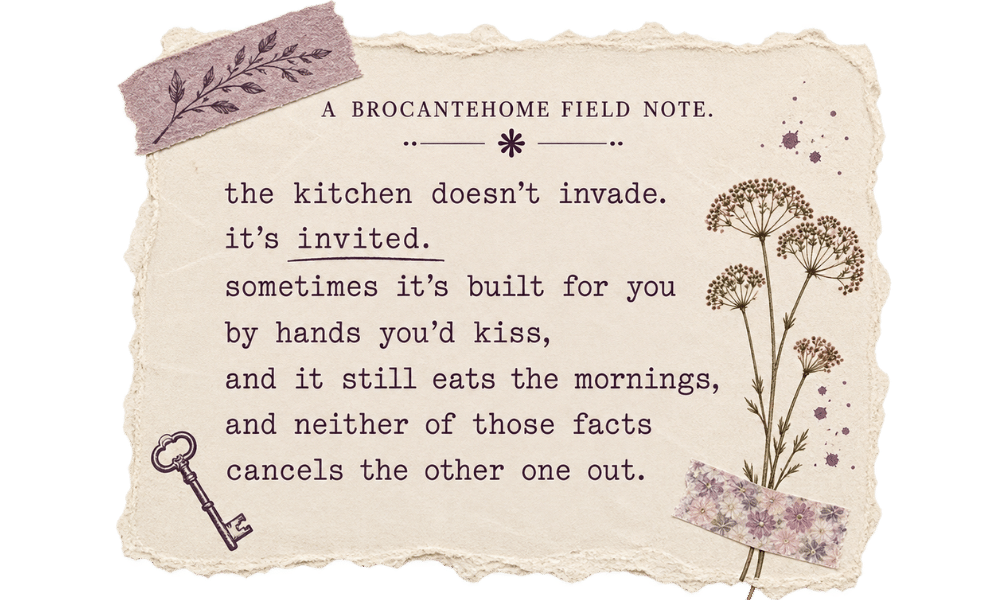
Gilman, being kinder than life, gives Malda a rescuer: Ford proposes, but only on the condition that she gives up the cooking, because it was the woman who made things he fell for, and he’d like her back please. It’s the least convincing thing in the story. Most of us have to do our own withdrawing, without a man appearing on the porch to explain that our work was the interesting part all along.
(I’d read that story. Sequel. The Cottagette 2: Nobody Come.)
an art whose medium is vanishing
Domestic work might be the only art form whose material is time and whose finished piece dissolves on contact with the world.
A meal cooked and eaten. A floor cleaned and walked across. A bed made and unmade. Clothes washed and worn and back in the basket by teatime. The labour is entirely real. The evidence is always on loan.
Whereas creative work accumulates, and flatters us accordingly. A page becomes ten pages. A sketch becomes a painting. Squares become a quilt. You can point afterwards and say there, I made that, and be believed.
I’m thinking about Penelope of The Odyssey fame, at her loom, waiting twenty years for a husband who might well be dead, with a houseful of men downstairs eating her food and demanding she choose a new one. She tells them she’ll decide the moment her weaving’s finished. Then every night, by torchlight, she quietly unpicks the day’s work, so that the weaving is never finished.
Three years she got away with it.
We’re told she did it to hold them off, and she did, and I’m thinking it’s also the most exact description of housekeeping anybody has ever committed to paper.
work done in daylight. undone in the dark. begun again in the morning.
The colossal patience of it never once mistaken for art, not by her, not by anybody, not in three thousand years.
there are monks who spend three weeks bent over a mandala made of coloured sand and then sweep the whole thing into a river and we call it profound.
women do very nearly the same thing every single day of their lives in kitchens and we call it nothing at all.
And I’m thinking too of the beef stew in the middle of To the Lighthouse, if you’ve never been near it. Virginia Woolf, 1927. A woman called Mrs Ramsay is holding a summer house full of guests together on a Scottish island, and the whole novel gathers itself around a dish that has taken three days to make. She gets it to the table. The candles are lit. And for about forty minutes everybody in that room is happy at the same time, which almost never happens in a life, and Mrs Ramsay knows even while it’s happening that it’s already going.
Three days of work. Forty minutes. Nothing left by morning but plates.
Woolf knew precisely what she was showing us: that the making of an evening is real work, and that it will not survive the washing-up.
the oppression was never the saucepan
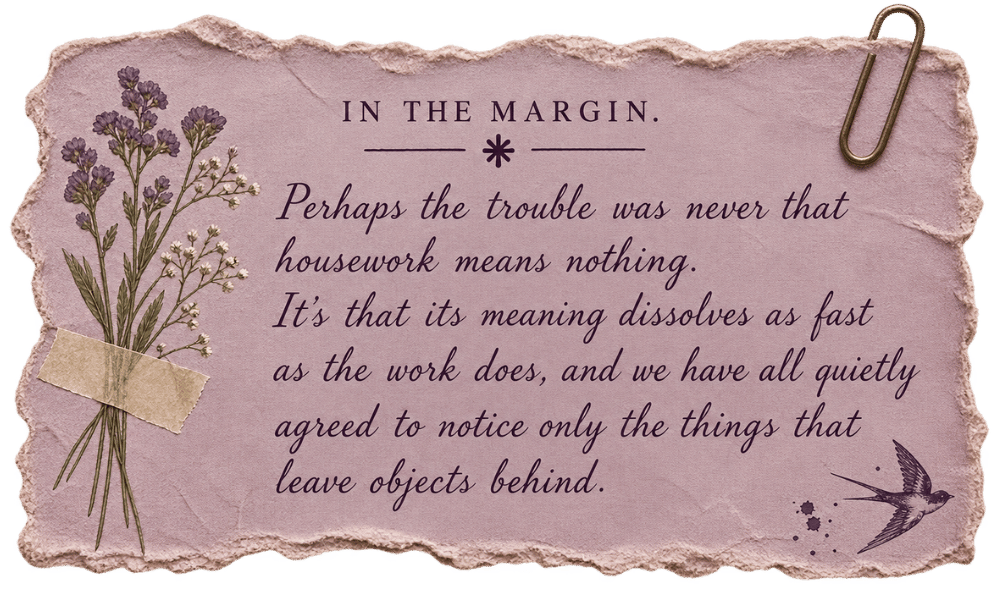
There is a long and unfortunate habit of confusing the cage with whatever the woman happened to be holding when she was locked into it. So cooking becomes suspect. Sewing becomes suspect. Housekeeping becomes evidence of a (trivial) mind that hasn’t yet caught up, and decoration becomes frivolity you were supposed to outgrow the moment you got serious about anything.
But it’s a strange sort of politics that declares an entire category of work worthless on the grounds that women were the ones doing it, surely?
There is nothing oppressive about a saucepan.
Nobody was ever pinned to the laundry room door by a jar of lavender water.
The oppression lives elsewhere, always: in compulsion, in economic dependence, in the assumption that domestic labour was naturally female and therefore hardly labour, and in the quieter and far more corrosive idea that a woman’s attention may be interrupted at any moment because nothing she is doing could possibly outrank a request.
could you just.
sorry, quick question.
where’s the.
have we got any.
And plenty of us love the work. Not obediently. Nobody insisted we love it. We just do. We love houses and food and old plates and redwork linen and the small polka of laying a table and the satisfaction of a room that has finally feels right. So it would surely be a peculiar sort of liberation that asked us to distrust that because our grandmothers had no choice about it, would’t it?
The useful question was never why are you making the dinner.
It’s do you still belong to yourself while you make it.
things i have done instead of the thing i meant to do
(with apologies to Sei Shōnagon, a woman at the Japanese court a thousand years ago who kept a “pillowbook” full of lists: things that make the heart beat faster, things that have lost their power, things it’s frustrating to be in the middle of. She made lists for the same reason we all do, which is that a list is a way of proving a life happened.)
Rearranged the spice jars by height, then by mood.
Read the label of a cleaning product all the way through, including the bit in German.
Discovered a receipt from a shop that no longer exists and stood there being sad about a shop.
Watered a plant that was already
deadresting.Deleted eleven photographs of the same window.
Went on a mission to find a letter I lost twenty years ago.
Looked for the good scissors.
Looked for the good scissors.
Wiped a surface that a passing stranger would have described as clean. Thrice.
Thought about the woman I’d be if nobody could get to me before noon, and felt something in my chest go tight and hot and slightly violent, and then put the kettle on.
housekeeping as authorship
A woman keeping a house is handling material: light, warmth, colour, texture, food, scent, season, memory, rhythm. She edits composes takes things away.
Move a lamp and the emotional temperature of a room changes.
Put a meal on a table and an evening becomes an occasion.
Open a window in February for four minutes and the entire house resets.
Give a tired friend her tea in the good cup, and something gets said between you that neither of you would ever put into words, and both of you hear it.
this isn’t decoration. it’s the deliberate handling of atmosphere, and atmosphere goes to work on people whether or not they can name what’s happening to them.
We all know within seconds when we’ve walked into a house that’s cared for. We know the other thing too: the room that’s frantic, or over-controlled, or gone quiet in the wrong way. You can read an entire household from its hallway. You can read a marriage from a fridge door.
Not everything qualifies, obviously. There is nothing creative about scrubbing the loo. But housekeeping in the larger sense, the making and the endless remaking of a place to live in, holds an enormous amount of creative possibility, and here I mean:
building a Christmas your children will carry into houses you’ll never stand in.
making peace with an ugly bathroom by hanging something ridiculous in it.
finally understanding that you need a chair by the bedroom window because that is where you think, and that this is not a whim, it’s a working condition, and men have been calling such things the study for centuries and having doors fitted.
And it isn’t obedience. It’s authorship. Choosing. Editing. Writing yourself in to your own story.
the trouble with “finding your creativity”
There’s another trap out there and it arrives dressed as encouragement, which is how the best traps always arrive isn’t it?
you must find an outlet. they say.
there’s always an outlet. ideally something involving clay. They say.
The modern woman apparently requires a hobby, a practice, a notebook, a sourdough starter, a morning routine involving light, and a small business selling hand-thrown incense holders before anybody will certify her as fully alive. She must be making. She must be pouring into her cup. She must have a thing that’s hers, and it must be photographable, and ideally it must eventually turn a profit, because a pleasure that earns nothing has started to look like a moral failure and I would like us all to question when exactly that happened. Was it Instagram?
Because we have turned creativity into one more form of self-improvement, which is the very last thing exhausted women need handing to them at fifty-three.
You don’t need a novel in a drawer.
You don’t have to take up watercolours.
You don’t have to monetise your knitting. ~~Please don’t monetise your knitting~~ Hell, monetise your knitting if you want to, I’m not the boss of anybody, but do it because you want the money and not because you’ve absorbed the idea that unpaid delight is a waste of a woman.
You DON’T have to re-discover yourself in your “art”. There might be nothing to rediscover, because possibly nothing was lost. Possibly you have been making things all along, in forms nobody ever taught you to recognise as making:
a birthday. a ritual. a garden. a family language, the private vocabulary of a household, words your children will use in their forties and have to explain to their partners (bappels and passels in our house). a way of welcoming people through a door. a Christmas morning three generations now perform without knowing you invented it. a life. an actual life, which is quite the object.
And if you’re making nothing at all this year, that’s permitted too. There are seasons with ideas falling out of your pockets and seasons when what you need is sleep, and the second kind is not a failure of the first kind.
creativity isn’t homework.
I’d underline that twice but she doesn’t like it when I shout.
the inventory
what making things and keeping a house have most deeply in common is attention.
A writer notices what everybody else walks past. A gardener notices the soil turning before there’s anything to see. A woman keeping a house notices the room: the light’s wrong, the fruit needs using, somebody’s gone quiet, the place smells shut up, the afternoon’s turned cold.
This has been called instinct for about a hundred and fifty years, which has been a marvellously convenient way of not calling it labour. It’s learned. And it costs. And the price is this: the woman who notices everything becomes responsible for everything she notices.
but there’s a stranger cost underneath that one and it’s the reason i keep going back to gilman’s little story: the noticing doesn’t switch off.
somewhere behind whatever else she’s doing, an inventory is running. it counts the milk. it knows how many clean towels are left. it wakes at four in the morning to review the dentist and the birthday and the thing she said in june that came out wrong and the fact that there’s something in the freezer that’s been in the freezer since christmas.
She writes her paragraph with one ear on the washing machine.
She thinks with a portion of her mind permanently rented out to other people at a rate nobody ever agreed.
So the problem was never only the quantity of the work. It’s what the work does to concentration. Certain things simply cannot be made in fragments. There are depths you can only reach with a long clear run at them, and a woman who has been interrupted every eleven minutes since 1994 has not been given one.
So we as a species. adapted, becoming extraordinarily good at working in ten-minute pieces and there is something heroic in that adaptability but I refuse point blank to romanticise it into a virtue, because a virtue is a thing you can then be expected to keep providing. And I don’t want to. And neither should you.
Sometimes the door has to close.
Sometimes the family can find its own socks
sido’s cactus
Colette was a French novelist, and the great subject underneath everything she wrote was her mother, a gardener in a Burgundy village, known to us all as Sido.
I talk a lot about Colette and Sido because I’m fascinated by. their dynamic, not least of all i the tale I am about to tell.
Sido was invited, in her seventies, to spend a week at her daughter’s house, but she wrote back to say she couldn’t. Colette kept the letter and put it into a book years later, where it has been quietly detonating in women’s hands ever since.
She couldn’t, Sido explained, because her pink cactus was about to flower. It flowered rarely, once in several years, and she was old enough to know that if she went away and missed it there might not be another.
An old woman refused a journey to a daughter she adored.
For a flower.
You can read that as eccentricity if you want to. But I like to think of it as the most complete statement of sovereignty I’ve ever encountered. Sido worked out what deserved her that week and it wasn’t duty and it wasn’t habit and it wasn’t even love. It was the one thing on the entire list that could not be rescheduled.
because almost everything a house asks of us can be rescheduled. almost all of it. that’s the secret nobody hands you at twenty-five and most of us don’t work it out until the far side of fifty, standing in a non-existent kitchen, holding a jug and a hammer and a shoe.
an interlude in which everybody goes slightly mad, and rightly so
Somewhere around here I want to put a book into your hands, and I want to do it badly, without explaining it properly, because explaining it would spoil it.
Leonora Carrington was an English girl who was thrown out of two convent schools, ran off to Paris at nineteen with a surrealist painter, and spent the rest of her long life in Mexico making paintings full of horses and hooded women and animals doing things animals shouldn’t. In her fifties she wrote a novel called The Hearing Trumpet.
Its heroine is ninety-two, deaf, has a small beard she rather likes, and is given an ear trumpet by a friend, through which she promptly overhears her family arranging to put her in a home. What follows involves the institution, a great deal of very bad food, and eventually the end of the world, and it’s the funniest and most serious book about old women I know.
Carrington cooked constantly, and fed her guests things that may or may not have been dinner. There’s a story, probably improved in the telling, about an omelette made with hair cut from her sleeping visitors. I don’t much care whether it’s true, because the story is doing real work: the kitchen as a laboratory, the pan as the place where things become other things, and the old woman not as a used-up servant but as the one who knows what goes in and what comes out.
We used to know this. The Greeks gave the hearth its own goddess, Hestia, and she took the first offering at every meal and the last, and no household could be founded without carrying fire from the old hearth to the new one.
Then somebody quietly reclassified the lot of it as chores.
I’m not suggesting we return to anything. I am someone who wants to live in the ow and explore it’s possibilities. But I am suggesting that the woman at the stove has been, at various points in human history, considered the most powerful person in the building, and that the loss of that idea has cost us more than we’ve noticed.
a brief defence of neglect
There are mornings when the most creative domestic act available to you is refusing to do any domestic work whatsoever, and this is worth saying and remembering
leave it.
leave the beds.
leave the pile.
let dinner be eggs and let everybody cope.
not forever. just long enough.
A house is remarkably resistant to catastrophe. It will survive you, in fact it fully intends to. Very little in it is anything like as urgent as it looks, and one of the more useful discoveries life finally gets round to whispering is that the washing will still be there tonight, but the thought might not.
Prioritise the thought!! Preserve the fragile thing before you tend the durable one. Please?
Because the house is durable, but the idea flickering behind your eyes is a moth in a draught. Catch it. The sink can have you later, the sink is always going to have you later, the sink is not going anywhere and I cannot promise it will ever leave you alone. Come to terms with that and choose what is calling to you regardless.
Sometimes the correct domestic decision is to abandon the domestic. To show the house who is boss. To let things go so you can let yourself BE.
but the kitchen is not the enemy
There is a real danger in taking Gilman’s problem and solving it only by escaping domesticity’s clutches, and I want to slow down, because I’ve watched women talk themselves out of the ordinary pleasures.
Sometimes chopping onions is exactly where the mind unknots itself.
Sometimes kneading dough is the thing that brings a woman back into her own body after a week spent almost entirely in her head, in her phone, in other people’s opinions.
Sometimes you’ve been at a screen for four hours and the single most intelligent act available to you is to go and peel potatoes and let the hands work while the rest of you sorts itself out underneath, which it will and we might ever know why, we just have to trust the process.
And creative work consumes too. We don’t say so nearly often enough, because creative work carries prestige and prestige buys silence. And accomodation.
But
The unfinished book eats the evening.
The business eats Sunday.
The project eats the marriage while everybody stands round admiring your dedication.
A life can be overrun by absolutely anything, including the thing you love most, especially the thing you love most.
So the goal was never to rank creativity above domesticity. The goal is sovereignty. Choosing, as often as circumstances allow, what deserves you now. The paragraph or the potatoes. Desk or duster. Sex or sleep.
There’ll never be balance, thank god.
balance is terribly still. life is a dance. I want to keep dancing.
gilman got her wish and it arrived on a moped
Ok. Here’s the thing I’ve been circling for four thousand words, and I know you know but I need to keep re-visiting it.
I live in a house with no kitchen.
Not as a philosophy, or some clever experiment I set up to see what would happen. I live in a house that’s half taken apart and we are in the fourteenth month of a sale that keeps not happening, and the kitchen is one of the many things this house currently doesn’t have.
So we eat the way Malda ate before Lois got hold of her. Food arrives from invisible kitchens, cooked by people I will never see.
Gilman imagined a central kitchen, professionally run, the labour done properly and paid for properly, so that a woman’s hours could be given back to her. She thought about this for years. She wrote whole books about it.
And it’s here. It came. It’s on my phone.
Now. Two true things I can’t make proper sense of.
The first is that it works. It works appallingly well. I’ve got the mornings back, all of them, whole and uninterrupted and mine, and I have never in my life been more focused or made more work or thought more clearly than I have in this ruined kitchenless house. Nothing needs defrosting. Nothing is soaking. There’s no six o’clock closing in on the afternoon like a tide. I sit down at seven with a thought and at one o’clock I’m still holding it.
The second is that I hate it. Not the food. The food’s fine, passable, ok, the food’s the least of it. What’s gone is the choosing. I miss the choosing.
Deciding what we’d have. Standing in Booths working out what the day tastes like. Buying something seasonal because it looks good and then building the rest of the week round it. Making an occasion out of an ordinary evening because I felt like it, because there were candles, because somebody was sad, because it was raining, because I love him. Feeding people with my own hands and watching their faces do the thing faces do when the ordinary pleasures take possession of the evening.
Not labour: authorship, and I’ve had it taken off me by a building site.
Gilman couldn’t have kow, so this isn’t a criticism of a woman who’s been dead for ninety years. Her kitchenless life had a hall in it. A long table. Everybody’s food carried to one place and eaten together, cooked by workers with proper wages and proper standing.
what i’ve got is a box at a door, all too often delivered by those who have no choice, and I’m uncomfortable with that.
Same idea. Opposite soul. The collective bit, the community, was deleted and what’s left is the convenience and the solitude and somebody on a bike being timed to the second so my hours can be given back to me. That’s a bargain I never agreed to and can’t currently get out of. And I repeat, I’m uncomfortable with that.
So no, I’m not going to tie this up in a pretty ribbon because I’m trying to fathom what is true here.
I’ve spent more than twenty years writing about the beauty of domestic life and I’m now obliged to report that I’ve made more work, and better work, in the months since it was taken away from me than in any year I had a kitchen. I don’t know what to do with that. I turn it over most days. I keep waiting for it to resolve itself and it won’t.
And there’s a worse possibility, which I’ve been carefully not examining.
It’s the fourteenth month. The house is half taken apart and we can’t put it back and we can’t leave it and the sale is’t movig and I’m tearing my hair out. But a woman whose life has stopped will find somewhere to put herself, and I have put myself into the work.
so perhaps i’m not focused at all, PERHAPS I’M STUCK, and focus is only what stuck looks like from the outside.
I don’t think that cancels any of it. The work’s good. I know it’s good, and it exists, and nobody can un-write it. But it does mean I ought to be careful about the conclusion I was so very nearly about to draw, which was that the kitchen had been robbing me blind for thirty years.
Maybe the kitchen was never the thing holding me back.
Maybe I’m just a woman in a house that stopped, working like the devil because the work is the only room in this life with a door that opens.
What I’ve got so far is this, and it’s small, and it’ll have to do.
The thing I lost was never the cooking. It was the deciding, and the deciding is portable. It’ll live in a plate and a candle and a cloth on a table and a delivery box tipped into an actual dish because I’m not an animal. The authorship survives the kitchen. It turns out the kitchen was only ever where I happened to be keeping it.
And I want the kitchen back.
Both. I want both. I’m old enough now to know that wanting both isn’t greed. It’s just the correct amount to want. And I am allowed to want, no matter what obligation virtue creates.
the house as self-portrait
Look round your rooms. Properly. The way you’d look at somebody else’s, with that faint delicious judgement you’d never admit to. (I see ya. I see myself)
You’re already there. In the books and the colours. In the objects you couldn’t explain to a stranger. In the chair everybody else thinks is hideous. In the cupboard full of jars. In the neglected corner and the stack of notebooks and the entire visible evidence of your obsessions, including the ones you’ve abandoned and the ones you haven’t yet got organised enough to start.
A home doesn’t represent identity. It records it. And it changes as we change, sometimes across a decade, sometimes across a single unhinged Saturday afternoon.
A woman leaves a marriage and paints the bedroom the colour he hated.
Her children go and the small room becomes a studio.
She turns fifty and finds she cannot bear the dining table she has tolerated for nineteen years, cannot look at it, cannot sit at it, and by Sunday it’s gone.
She buys yellow curtains. She throws out thirty mugs. Twelve. Thirty. She grows herbs on the sill, stops entertaining people she doesn’t like, moves the bed under the window so she can see the sky when she can’t sleep, which is often now, which is fine, which is a different essay.
the house moves with her.
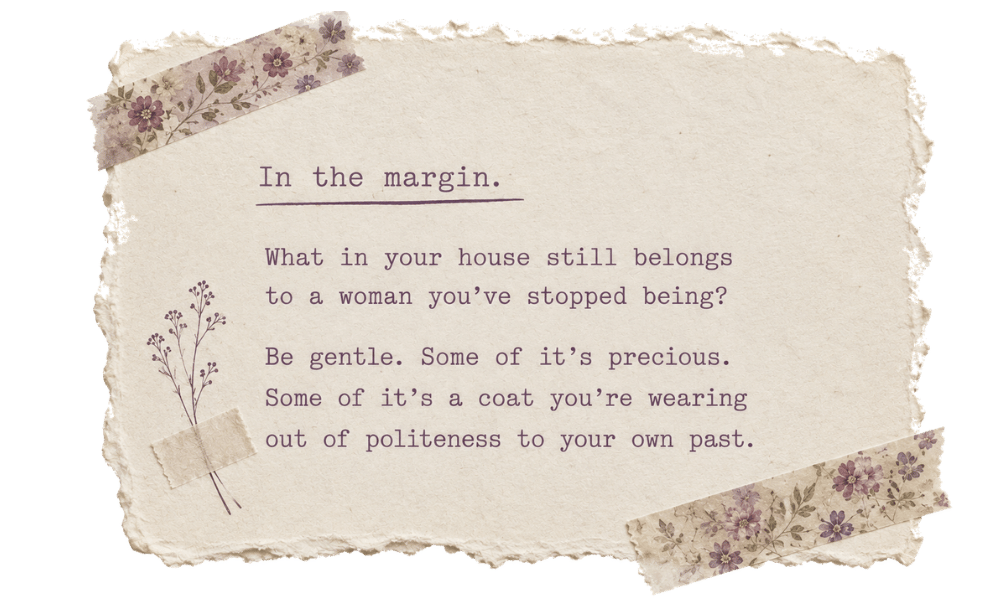
And what it produces isn’t a portrait of the self. It’s the conditions in which a self can carry on becoming, which at our age is the only thing worth building.
the art of doing it again
Domestic life is repetitive, which is both its great insult and its great beauty.
again. tea. again. beds. again. morning. again. again. a-bloody-gain.
Our culture prefers completion. We like finished things: the ending, the signature in the corner, the degree awarded, the certificate, the launch, the done. A house refuses closure entirely. There’ll always be another meal and another morning and no ceremony is ever held, no medal struck, nobody claps.
But recurrence has an artistry of its own, and it’s slow, and it works on the people you love while they’re too young to know it’s happening. The gestures we repeat become the substantial, necessary, beautiful stuff of memory.
Saturday breakfast. The lamp switched on before dusk. The smell of polish in a hallway. The radio going while the dinner cooks. Clean sheets on a Sunday. The little plate left beside somebody’s bed. The teey present tucked uder the pillow every Friday night. The specific sound of your Mum in the kitchen, which you’d recognise anywhere, thirty years later, in a stranger’s house, and have to sit down.
Nobody announces that these things matter while they’re happening.
Then twenty years pass and they turn out to be almost everything anybody remembers.
Perhaps that’s the hidden power of domestic making. It doesn’t produce objects. It produces continuity, which is the only thing that’s ever genuinely inherited, and it’s made out of mornings exactly like the ones you should be fighting tooth and nail to make your own.
and tomorrow morning
Tomorrow morning there’ll be evidence of yesterday waiting in your kitchen. There always is, and I’d give my left arm to have some. A mug. A crumb. A tea towel slid off its hook. Something requiring attention.
You may attend to it. You may even enjoy attending to it, window open, coffee made, the day beginning properly, and if that’s the morning you want then take it and take it gladly, because that is also a life well spent. The daily round.
or there may be something else, calling louder.
your commonplace book
a dress you want to alter.
the half-read novel with the vintage postcard holding your page.
a letter you owe somebody who won’t be here forever.
a business idea you’ve been carrying round for eight months without once writing down, which is a thing i’d like you to think about, honestly, eight months.
a glorious hour of nothing useful whatsoever.
And when the inventory starts up its patient little list, you might remember that the house exists to hold your life, and your life does not exist to satisfy the house.
Some days you’ll give yourself to it.
Some days you’ll make something inside it.
Some days you’ll make the house itself, which is its own kind of authorship and always was.
And some mornings, wonderfully, unreasonably, you’ll leave the kitchen exactly as it is, jug and hammer and shoe and all, and go back up to the bed under the window where the thought is still faintly burning, and shut the door behind you.
Somewhere a long way back there’s a young woman getting out of a bath, holding a book she’s fairly sure is about somebody else, going down to a kitchen a man built for her with his own two hands.
I wouldn’t warn her. There’s nothing to warn her about. The kitchen was beautiful and she was right to love it and the boy was worth every hour.
I’d only like her to know, ~~for later~~ for much, much later, when she’s standing in this empty kitchen holding a jar and a charger and one shoe:
the house was always meant to hold the life.
and never the other way round.
because the morning is yours.
and you have other work to do.
This expresses so much of what’s been there, unverbalized, in my mind. Thank you for capturing the endlessly nuanced dance of domesticity and reminding us of its deep value AND that it doesn’t encompass us entirely—that we are still free to visit those neglected rooms and close the door on the rest of the house and finally fully BREATHE.