

The Kept Hours
Wholly Inhabiting the Home You Have Now

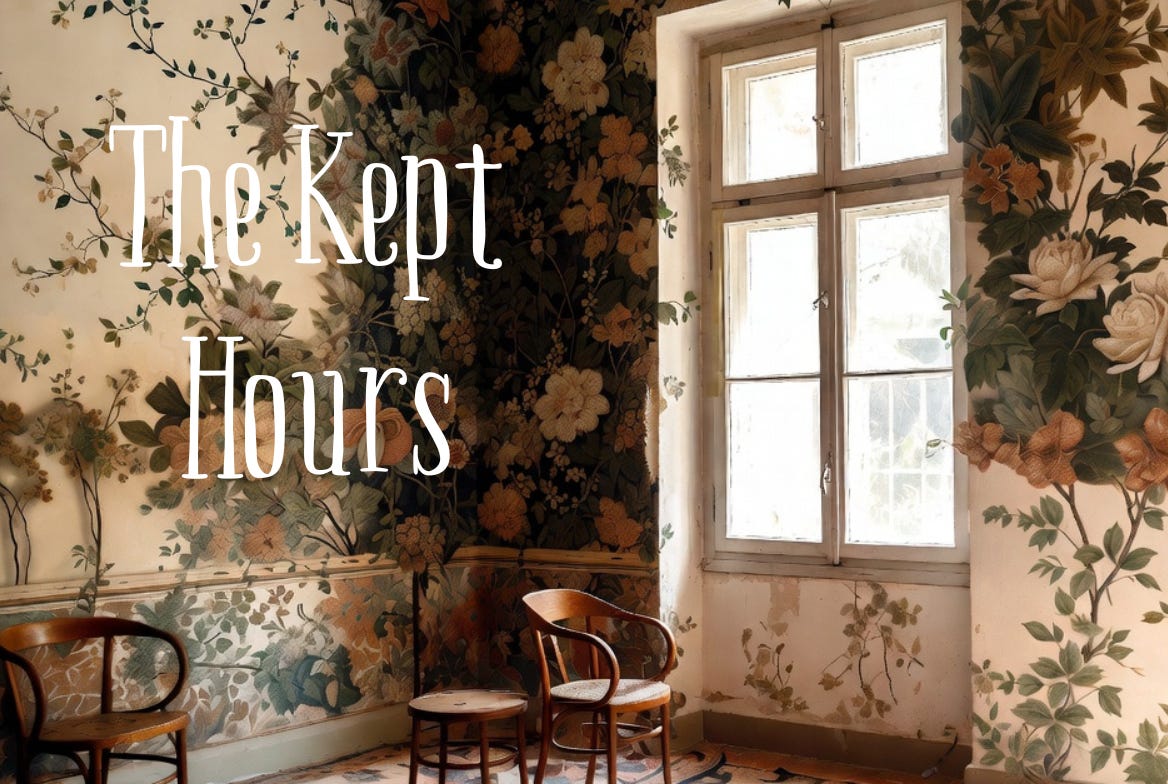
At the beginning of the year, I created a course called The Glorious Mess. It was divided into two parts: The Glorious Mess itself - eight weeks of intense permission to loosen your grip on what life should be and to instead allow yourself to live out loud in all your emotional and historical mess… and The Kept Hours, a gentler, more whimsical invitation to inhabit your home as your wholly messy self, wild and true and as aware of your own needs as you need to be.
You see I want you to find yourself, one afternoon soon, sitting on your own sofa, simply feeling that things are just how they should be. That you are at home both physically and emotionally and that you feel centred, and at peace.
Most women have stolen an afternoon like this at least once.
Nothing is happening in it. There is no occasion, no productivity, no one being looked after or impressed or fed on time. It is simply an afternoon in a house that is yours, in a life that is yours, with nowhere you absolutely have to be for the next few hours. The light is gentle. Something is simmering, even if it is only a few herbs to scent the air and there is a book with its spine broken open on the arm of the chair.
You might have had one of these afternoons, briefly, accidentally, and then felt obscurely guilty about it, as though you had used time that wasn’t really yours to use.
The Kept Hours is about changing that.
Perhaps you’ve already done some burning. Maybe you’ve already stood in the glorious mess of a life being unmade and remade and thought: right. Okay. What now? Or perhaps you’ve arrived here fresh, without the bonfire, just with the quiet and growing sense that something in your life needs tending rather than performing. Either way, you’re in the right place. The Kept Hours doesn’t ask where you’ve been. It only asks what you want the next hours to feel like.
Here is what they can feel like: hours that are kept for you rather than spent on everything else. Hours that tend to the inner life the way a good kitchen tends to hunger: practically, warmly, and without fuss. Hours that accumulate, quietly, into a life that actually feels like yours.
Here is how we are going to do it, once the Glorious Mess is completed…
We will begin at the threshold, which is where all good things begin, with May Sarton and the question of what it actually means to come home to yourself. Not to go back. To arrive, possibly for the first time. From there we move into the kitchen, because the kitchen is always where the real conversation happens, and M.F.K. Fisher is waiting there with something wonderful and the absolute conviction that feeding yourself well, alone, on a Tuesday, is not sad. It is, she would tell you, the full expression of self-regard. If the glorious mess was about stopping the performance, this is about learning what you actually want to eat.
Week Three takes us to the larder, which sounds unpromising and is in fact where everything gets interesting. Elizabeth David will help you think about what you actually want filling your cupboards, your shelves, your hours, and what you have simply been keeping out of habit, or guilt, or the vague sense that you ought to. Week Four is the sitting room. Laurie Colwin, warm and entirely unimpressed by fuss, has things to say about the radical art of staying in. The right lamp. The good evening. Nothing required of you except presence. Not the presence you perform for other people. The kind that is just you, in a room, being quietly and entirely yourself.
Halfway through, we go outside, just as far as the garden wall, because Colette is there and she will not come indoors, and honestly you probably need the air. Week Five is about what you tend and what you let grow wild, in a garden and in a self. Colette as your muse for the overgrown parts you’ve been apologising for. The gloriously messy self needs a garden that matches her, it turns out. From the garden we come back inside to the writing desk, where Katherine Mansfield is waiting to tell you that noticing is enough. That your interior life is not a luxury or a hobby. That the room your thoughts live in deserves the same attention as every other room in the house.
Week Seven is the linen cupboard, which is, unexpectedly, I think, the most spiritual stop on the tour. Kathleen Norris found the sacred in laundry. In repetition. In the small daily acts that most of us do on autopilot and most productivity culture tells us to outsource. She called it the quotidian mysteries and she was right. Week Eight is the bedroom, and Anne Morrow Lindbergh, and the subject of rest as something you are allowed. Sleep. The slow morning. Stillness that is not laziness but attention. The bedroom as the room where you are, finally, no one’s anything except your own. Belonging, finally, to yourself, knowing that after all that magnificent mess, this is what rest actually feels like.
Week Nine brings us to the whole house, all of it, seen fresh, and Alexandra Stoddard, who spent her entire career arguing that beauty is not an aesthetic project but a daily act of love toward yourself. What does your house know about you that you’ve been ignoring? And then Week Ten. The inner room. Rumer Godden wrote that every person contains four rooms: physical, mental, emotional, spiritual, and that most of us never open the fourth. Ten weeks of kept hours have been leading here. This is the one you finally unlock. And unlike every other room you’ve ever tidied for company, this one you get to leave exactly as you find it.
The women keeping you company through all of this are not life coaches or wellness advocates or anyone with a morning routine to sell you. They are writers and sensualists and fierce keepers of the domestic as a serious human endeavour. They already knew what you are in the process of learning: that a tended life, a life in which you pay attention to the quality of the light and the warmth of the cup and the slow pleasure of an afternoon that belongs entirely to you, is not a small life. It is not a lesser life than the loud, burning, glorious one that brought you here. It is, in fact, the whole thing.
A note though, about what this is not: It is not about making your home beautiful in the magazine sense, though beauty will come into it. It is not about simplifying, decluttering, optimising. The Kept Hours has no interest in turning your ordinary life into a wellness project. What it is interested in is this: the particular pleasure of being a woman in a house that knows her. The sensory, specific, unambitious joy of a day that fits…
You don’t need to have done anything in particular before arriving here. You don’t need to have burned everything down, though perhaps you have. You need only to be a woman who suspects, somewhere under the noise and the obligation and the years of magnificent usefulness, that there are hours with your name on them.
Hours that have been waiting, just for you.
Ready to get started?
The Glorious Mess + The Kept Hours Bundles: 18 weeks of guided essays, workbooks, to-do lists, resources and more is your for just $49.00.
Divided into two stand-alone courses, that you can do consecutively or entirely separately, both designed to help you understand that a tidy life isn’t always an authentic one, and its only when we give ourselves permission to sink into the velvet comfort of our most authentic selves that we will finally enjoy some semblance of peace…
Should you decide to join today you will find The Glorious Mess complete and The Kept Hours just beginning, so you can choose your path depending on what feels most urgent right now: a deep dive into examining your life and all the ways you have been trying to keep life as tidy as can be at the expense of your heart, OR taking that heart into your home and making a sanctuary that doesn’t make a pin-cushion out of you…
PS: The Glorious Mess + The Kept Hours comes as part of my lovely LIBRARY subscription and should you be interested in starting your very own Brocante journey, then you can join today from just $29.00 per month for all my courses and downloads…
The Glorious Mess is taking me time to get through but it’s got to be one of the most important courses of yours I’ve worked through. Looking forward to The Kept Hours as well. Thank you Alison!